As thousands of postgraduate students and early-career academics plan their eligibility for lectureship and Junior Research Fellowship (JRF), attention has turned to the National Eligibility Test (NET) to be conducted by the National Testing Agency. While the detailed calendar for UGC NET 2026 has not yet been notified, the examination continues to follow a well-defined statutory framework set by the University Grants Commission and administered by the National Testing Agency. This article explains what candidates can reliably expect for the 2026 cycle, based strictly on official information available so far, and clarifies what has not yet been announced.
Background: what UGC NET is and why it matters
The University Grants Commission National Eligibility Test is a qualifying examination used to determine eligibility for appointment as Assistant Professor in Indian universities and colleges, and for the award of the Junior Research Fellowship. The examination is conducted on behalf of the University Grants Commission by the National Testing Agency. The academic and regulatory framework governing eligibility, subjects and outcomes is defined by the University Grants Commission.
Since 2018, the NTA has been responsible for administering UGC NET, including application processing, conduct of computer-based tests, answer keys, results and certificates. The examination is held multiple times a year, depending on the academic calendar and administrative decisions of the Commission and the testing agency. Historically, cycles have been conducted in June and December, though this has varied in recent years due to administrative restructuring and exceptional circumstances.
UGC NET remains a gatekeeping examination for a large segment of India’s higher-education teaching workforce, as well as a key funding and career pathway for doctoral researchers through the JRF route.
Current status of UGC NET 2026 notifications
As of now, neither the National Testing Agency nor the University Grants Commission has issued a detailed notification specifically titled “UGC NET 2026” outlining exam dates, application windows or subject-wise schedules.
This absence of a formal 2026-labelled notification is not unusual. NTA typically announces NET cycles closer to the examination window, often clubbing them with month- or session-based nomenclature rather than year-long academic labels. Candidates are therefore advised to rely only on official notices published on the NTA website and through its public information bulletins, rather than on speculative timelines circulating on social media.
What is verified and publicly available is the continuation of the established NET framework, including eligibility conditions, exam pattern, syllabus structure and qualifying criteria, which are laid down in UGC regulations and reiterated in successive NTA information bulletins.
Eligibility framework: what remains unchanged
The core eligibility conditions for UGC NET are governed by UGC regulations and have remained stable across recent cycles.
To appear for the examination, a candidate must hold a postgraduate degree or equivalent qualification recognised by the University Grants Commission. The minimum percentage of marks required in the qualifying examination depends on the candidate’s category, as notified by UGC. Candidates who are in the final year of their postgraduate programme may also apply provisionally, subject to fulfilling degree requirements within the stipulated timeframe laid down by the Commission.
Age limits apply only for the award of Junior Research Fellowship. For eligibility for Assistant Professor, there is no upper age limit. These provisions are part of standing UGC policy and are reiterated in each examination notification issued by NTA.
For UGC NET 2026, there has been no officially notified change to these eligibility conditions.
Exam pattern: two-paper computer-based test
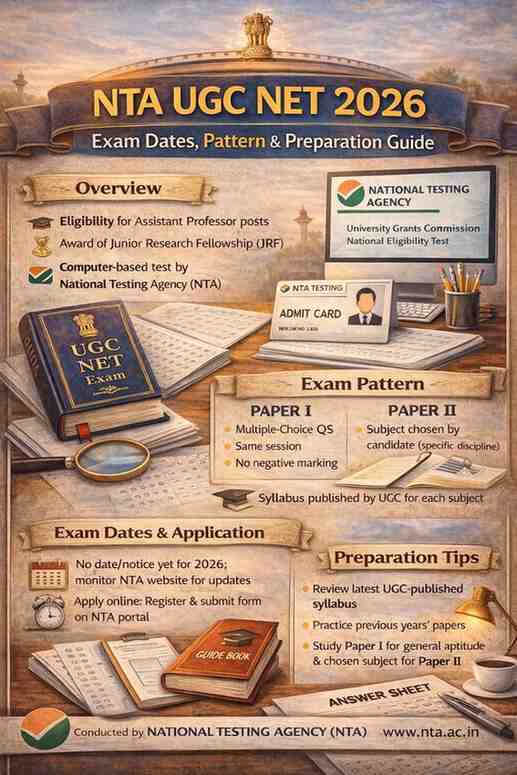
The UGC NET examination follows a standardised computer-based format consisting of two papers conducted in a single session.
Paper I is common to all candidates and is designed to assess teaching and research aptitude. It includes questions on reasoning ability, reading comprehension, divergent thinking, communication, data interpretation, information and communication technology, and higher-education systems.
Paper II is subject-specific. Candidates choose one subject from the list notified by the University Grants Commission, corresponding broadly to postgraduate disciplines offered by Indian universities. Questions in Paper II test in-depth knowledge of the chosen subject.
Both papers consist exclusively of multiple-choice questions. There is no negative marking, a feature that has been explicitly stated in NTA information bulletins for recent cycles. The total marks and number of questions have remained consistent across recent examinations, though candidates are advised to verify these details once the official 2026 information bulletin is released.
The examination is conducted in English and Hindi, except for language subjects where the medium corresponds to the subject chosen.
Syllabus structure and subject coverage
The syllabus for UGC NET is prescribed by the University Grants Commission and published subject-wise on official portals. Paper I syllabus is uniform across all disciplines and focuses on general academic competencies rather than domain-specific knowledge.
Paper II syllabus varies by subject and is detailed in individual syllabus documents issued by UGC. These syllabi are periodically reviewed but do not change on a year-to-year basis unless formally notified. As of now, there has been no announcement of syllabus revisions specifically for UGC NET 2026.
Candidates preparing for the 2026 cycle are therefore expected to rely on the latest officially published UGC NET syllabi, which remain valid until replaced or amended by a formal UGC notification.
Exam dates and frequency: what is known and what is not
The most common query among aspirants concerns the likely exam dates for UGC NET 2026. At present, there are no confirmed dates released by the National Testing Agency for a NET cycle labelled 2026.
Historically, NTA has conducted UGC NET examinations more than once a year, often aligning them with academic sessions rather than calendar years. Recent years have seen cycles identified by month or combined sessions, rather than by a single annual tag.
As a result, candidates should not assume a fixed “UGC NET 2026” schedule. Instead, they should track announcements on the NTA website, where examination calendars, advance notices and detailed information bulletins are published.
Any date or timeline circulating outside official NTA communications should be treated as unverified until confirmed through an official notice.
Application process: established digital workflow
The application process for UGC NET is conducted entirely online through the National Testing Agency’s application portal. While the portal for the 2026 cycle has not yet been activated, the procedural framework is well established.
Applicants are required to register using personal and academic details, select their subject and examination city preferences, upload scanned documents in prescribed formats, and pay the examination fee if applicable. Fee exemptions or concessions for specific categories are governed by UGC and Government of India norms and are detailed in the official information bulletin for each cycle.
Once the application window closes, NTA typically opens a limited correction window allowing candidates to rectify specific fields. Admit cards are issued online prior to the examination, and candidates must carry a printed copy along with valid photo identification to the examination centre.
There is no indication so far of any structural change to this application workflow for the 2026 cycle.
Qualifying criteria and result declaration
UGC NET is a qualifying examination, not a rank-based selection test. The University Grants Commission prescribes category-wise cut-off criteria, which are applied to determine eligibility for Assistant Professor and JRF.
The qualifying cut-offs are calculated subject-wise and category-wise, based on the performance of candidates in both papers combined. Separate lists are prepared for JRF eligibility and Assistant Professor eligibility.
The National Testing Agency publishes provisional answer keys, invites challenges, and then releases final answer keys before declaring results. E-certificates and JRF award letters are issued digitally through official portals.
There has been no official announcement of changes to this evaluation and result framework for UGC NET 2026.
Impact on aspirants and higher-education institutions
The absence of early notification for UGC NET 2026 has created uncertainty among aspirants who are planning doctoral admissions, teaching eligibility timelines and research funding applications. However, the stability of the exam pattern and syllabus mitigates some of this uncertainty, allowing candidates to prepare without fear of sudden structural changes.
For universities and colleges, UGC NET continues to function as a baseline eligibility filter rather than a recruitment examination. Institutions remain responsible for conducting their own selection processes for faculty appointments, using NET qualification as a mandatory or preferred criterion as per UGC regulations.
For doctoral candidates, JRF qualification through UGC NET continues to be a major source of centrally funded research fellowships, alongside other national schemes.
Preparation considerations grounded in official practice
While no official “preparation tips” are issued by the National Testing Agency, candidates can draw certain conclusions from the exam’s consistent structure.
Paper I rewards conceptual clarity in teaching-learning processes, research methods and logical reasoning rather than rote memorisation. Paper II requires thorough engagement with the officially notified syllabus, including awareness of core concepts, theoretical frameworks and contemporary developments within the discipline.
Since there is no negative marking, accuracy combined with attempt strategy plays a role in overall performance, though the qualifying nature of the exam means that clearing subject-wise cut-offs is more important than maximising raw scores.
Candidates are advised to rely on UGC-published syllabi and previous years’ question papers released by NTA as authentic reference material, rather than unverified third-party summaries.
What to watch for next
The key developments aspirants should monitor in the coming months are the release of an official UGC NET information bulletin by the National Testing Agency, activation of the online application portal, and publication of exam city and schedule details.
Any changes to syllabus, exam pattern, eligibility or qualifying criteria will be explicitly stated in the official notification. Until such changes are formally announced, the existing regulatory and examination framework remains in force.
Conclusion
UGC NET 2026, while not yet formally scheduled, is expected to follow the established structure defined by the University Grants Commission and administered by the National Testing Agency. Eligibility rules, exam pattern and syllabus remain stable in the absence of contrary official notification.
For aspirants, the most reliable strategy at this stage is to prepare in line with the existing syllabus and pattern, track official announcements closely, and avoid acting on speculative or unofficial information. In a system where regulatory clarity and procedural transparency are central, the official notification when issued will remain the sole authoritative source for all details related to the UGC NET 2026 cycle.